Growing a TSP Business: The Biggest Mistake to Avoid

Somewhere along the way, many Technology Solutions Partners have stopped having real conversations with their clients. Not intentionally. Not out of neglect. But in the race to deliver services, hit KPIs and stay ahead of the curve, dialogue has dropped off.

It’s more common than you’d think, and more damaging than it appears.

If this rings true for you and communication has drifted off-course, consider this a chance to realign your compass. Because staying connected to your clients is the foundation of long-term engagement, growth and success.

How a Lack of Client Focus is Hurting TSP’s

For many, client-centricity hasn’t disappeared – it’s just been deprioritised.

Owners and leaders are consumed by other business priorities: refining operations, managing people, finances, chasing scale. As such, client relationships often take a back seat. Strategic conversations are postponed. Casual lunches or check-ins disappear. The result? Relationships become transactional and reactive, rather than being proactive partnerships.

When TSP’s do not consistently engage with clients, they lose the ability to have an impact. This disconnect can make it harder to uncover new challenges, suggest better-fit solutions and stay ahead of the curve.

Because client needs evolve. Priorities shift. New technology solutions emerge. The “standard stack” you rolled out two years ago may no longer serve the client’s goals today.

To build a future-proof TSP, curiosity must come first. The only way to stay relevant and indispensable, to recommend the right tech, or the right strategy is to truly understand what’s really going on inside your client’s business.

Where Communication Breaks Down Inside the TSP Business

This isn’t just a leadership issue. Client communication is often breaking down across the entire company. And it’s costing relationships, trust and growth.

Let’s look at how communication gaps may be showing up across the business.

Account Management

Account Managers are often hiding behind emails. Many avoid running quarterly business reviews (QBRs) altogether, citing a lack of data or time. But more often than not, it comes down to a lack of confidence or curiosity. Instead of visiting or speaking with clients, or asking meaningful questions and following up, they default to emails or silence.

Support

It’s common to see support teams relying too heavily on PSA ticketing systems and rarely pick up the phone. As a result, clients feel like they’re talking into a void, creating a “black hole” experience, where their issues disappear and frustration builds.

Projects

When project teams receive sign off, they often don’t communicate with clients either. No kick-off calls. No progress updates. They’re so focused on delivery, clients get left out of the loop and are often left wondering what’s happening behind the scenes.

Finance

Finance Teams aren’t exempt either. Invoices are unclear or untransparent. Even with SLAs in place, line items may not align with client expectations, or what they they’re paying for. When billing queries arise, they may avoid conversations altogether. Instead of explaining the value or resolving confusion, the quickest fix becomes a credit memo.

Then, on occasions when receivables go unpaid, there may be follow up – but we don’t stop to ask why.

So, is communication in your TSP reinforcing trust, or (is a lack thereof) eroding it?

The Mindset Shift: From Commodity to Boutique

There needs to be a mindset shift in the industry towards client-first service. Most TSP’s aren’t high-volume machines – they’re boutique by nature. And boutique service demands more than technical delivery. It requires proactive, personalised client engagement.

This client-centric shift won’t happen on its own. It needs to be led by owners, by leaders. If you’re serious about building a client-centric TSP, talk about it. Prioritise it. Make client engagement a regular part of team conversations.

Ask the right questions: What are we doing? How are we doing it? And what impact does this have for the client?

Because if you’re not competing on price or standing out on experience – you’re sitting in the danger zone.

But, undergo a client-centric mindset shift? You’ll be empowered to build a stronger, more profitable business with longer-lasting client relationships.

Ready to re-centre your TSP around client engagement? Learn how Fractional Leadership & Advisory can help you lead the shift.

The Reality of Technology Business Growth: Why Mindset Matters More Than You Think

For many technology businesses, particularly Technology Providers, growth is seen as the ultimate goal. Revenue targets dominate the conversation: a $1 million business wants to reach $5 million. At $5 million, the new ambition is $10 million. And on and on it goes. 

This focus on ever-increasing figures is so common, it’s almost expected. But in many cases, these numbers are arbitrary, without being backed by a clear strategy or purpose. They’re often plucked from the air, driven more by perception than intention or execution.  

There’s a crucial difference between saying, “We want to be a $5 million business,” vs. “We’re building towards becoming a $5 million business.” One is aspirational. The other is actionable. 

Without a vision or plan behind the numbers, execution tends to stall. Despite all the talk about scaling, many technology businesses aren’t truly prepared (or even genuinely motivated) to grow in a sustainable, intentional way. 

Table of Contents:

Why Bigger Isn’t Always Better for TSPs

Many TSP’s say they want to grow, for example, from $1 million to $2–3 million. But when asked what that growth actually looks like, their vision doesn’t include expanding their team or adding complexity. They want to keep things lean, with a small staff count. There’s no appetite for becoming a 100-person operation, let alone a $100 million enterprise. 

This disconnect is common. The industry narrative tends to default to “more is better.” But the reality is, not every business owner wants, or needs to scale at all costs. 

Often, it takes an external voice to offer permission for them to think differently. The truth is, it’s okay to stay small. 

Some of the most successful technology services business owners have made a conscious decision to remain small and highly profitable. Instead of chasing top-line revenue, they prioritise extracting value from the business and investing it into personal wealth. 

That’s not to say TSP business growth isn’t a worthy goal. For some, scaling beyond $10 million (or even up to $30 million or $100 million) is the right path. But everyone’s definition of success is different and deeply personal. There’s no one-size-fits-all answer. 

As a business owner, the challenge might be that you haven’t yet taken the time to understand your own motivations. That’s why a framework around different owner mindsets can be helpful – it’s a way to clarify what kind of business you truly want to build. 

The 6 Owner Mindsets 

TSP business growth doesn’t just depend on market opportunity or operational capacity. It’s often shaped by your mindset. Seeing as not every technology business is on the same journey, understanding the mindset behind your business is key to making strategic decisions.  

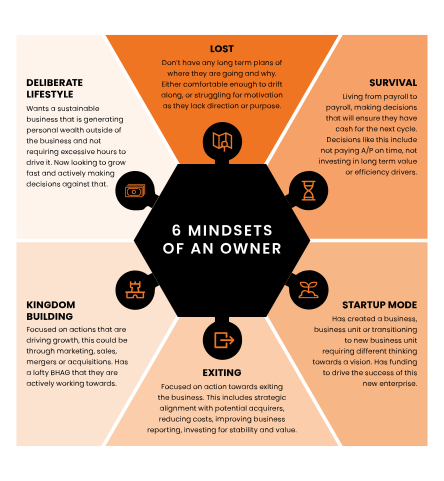
Typically, there are six distinct owner mindsets. Each one shapes how a business operates and what growth looks like.  

1. Exit-Oriented 

These owners are working intentionally toward a sale or transition. Their focus is on building value, systemising operations and preparing for the next stage: stepping back or cashing out. 

2. Kingdom Builders 

Driven by ambition, these owners are building empires. They’re aiming for scale, pushing towards a $100 million business, large teams and industry dominance. Growth is the mission. 

3. Deliberate 

These are lifestyle business owners who are clear and intentional. They’ve chosen to stay small, run efficiently and generate strong profits, often extracting wealth for personal investment. They prioritise freedom, control and financial outcomes over headcount. 

4. Survival Mode 

For these technology business owners, the daily reality is about staying afloat. Owners are focused on meeting payroll, covering costs and making it through to the next month. Growth isn’t even on the radar; survival is the only priority. 

5. Startup Mindset 

Early-stage owners are building from the ground up. These businesses are still testing, iterating and finding product-market fit. Energy is high, but resources are stretched. 

6. Lost 

The most common (and limiting) mindset is being lost. Owners aren’t actively choosing a path, building anything new, working toward an exit or pursuing a deliberate lifestyle business. While they may be running a decent operation and better positioned than “survival mode”, they lack a clear direction or vision for the future. 

6-Mindsets-of-an-Owner

Being in the “lost” mindset can feel deceptively comfortable, as your business may be profitable, even stable. But it’s directionless. And this is where growth stalls.  

Without a clear decision to transform or exit, many TSPs drift. They react instead of lead. They plateau instead of scale. 

Recognising where a business owner falls within these mindsets is a powerful first step. It creates clarity. And clarity can drive action. 

Looking at broader industry benchmarks, Canalys is projecting 20% (average) year-on-year revenue growth across major technology categories for channel partners. 

While that number might seem ambitious (or potentially even out of reach) for many TSPs, it reflects the growth potential that still exists in the market. The challenge is that a large portion of the industry has stagnated. 

Without a clear mindset or strategic direction, it’s easy to fall behind while the industry moves forward. 

Understanding growth potential starts with recognising how your mindset shapes the pace and trajectory of your business growth. 

The 4 Speeds of Business Growth 

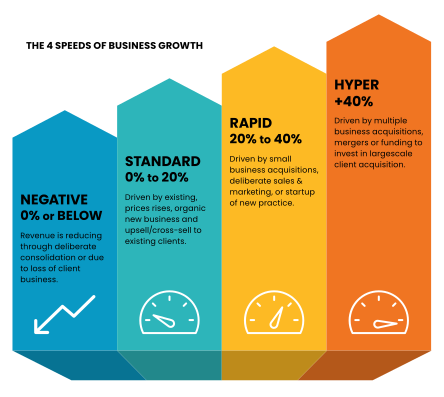
How does mindset impact growth? Let’s discuss the four distinct speeds at which technology businesses typically grow, each with their own operational reality and strategic demands.  

1. Hyper-Growth (40%+ year-on-year) 

At this speed, businesses are scaling aggressively. Hyper-growth businesses are often scaling aggressively, capturing new markets or rapidly expanding offerings. 

2. Rapid Growth (20-40% year-on-year) 

These businesses are expanding quickly but more sustainably than in hyper-growth. They’re often building on strong foundations, such a proven business model, consistent demand and operational discipline, to accelerate growth. 

3. Standard Growth (1-20% year-on-year) 

This is where many stable, well-run businesses sit. Growth may be steady and incremental, fuelled by continuous improvement, retention and small-scale market gains. 

4. Negative or Static Growth (0% or less) 

In this category, businesses are either flatlining or declining. They may be stuck due to market shifts, internal inefficiencies or a lack of direction. Without intervention, this can lead to long-term erosion of value. 

4-Speeds-of-Growth

When leading analysts point to a 20% growth opportunity, this aligns with what standard growth should look like: a solid, but achievable target. 

So why does hitting even standard growth feel so special, or so difficult for many TSPs? 

Even though 20% growth might seem substantial figuratively, the reality depends on your scale.  

For a $100 million business, for example, this might seem like a big leap. But for a $1 million TSP, 20% is only $200,000 in growth – which is the equivalent of a gaining few new clients, implementing a modest price increase or adding a few additional services. 

Yet, many businesses still struggle to achieve even this. 

That’s where mindset resurfaces as the limiting factor. If your business isn’t structured around profitability, creating a deliberate lifestyle, growth through acquisition or demand generation, or a pathway to exit, then it’s often drifting. It’s not stalled, but neither is it moving forward with purpose either. 

Rather, it’s a common state of “floating”. Owners haven’t taken the time to define what they truly want from their business. 

Growing a TSP business doesn’t always mean chasing hyper-growth. For many, sustainable growth comes from clarity, focus and aligning goals with the right mindset. 

So, the real question becomes: What do you want to be? What are you working toward? 

Because without a clear strategy or vision, even small growth targets can feel out of reach, and your business can end up reacting to the market, rather than leading within it. 

What Happens If You Do Nothing? 

As the market evolves, many of the core services offered by TSPs are becoming commoditised. Margins are tightening from all sides. Salaries are rising, inflation is pressuring overheads and SaaS margins continue to shrink as vendors push through price increases. 

These pressures aren’t isolated. They’re structural shifts that affect every technology service provider. 

So what happens if nothing changes? 

If your business is currently tracking at 10% year-on-year growth, you might think you’re on a steady path. But without proactive steps to adapt, that growth can evaporate, or even slip into decline. 

Client churn is also increasing – which is a trend that’s been widely observed and discussed. That creates dual pressure: protecting margins, while simultaneously improving retention. 

And the hard truth is that some churn factors are beyond your control, such as changing client needs, market consolidation and shifting budgets. 

So the real question becomes: If you can’t control what’s happening around you, what are you doing to take control of what’s happening within your business? 

Shifting Your Mindset Towards Growth 

Many technology solutions businesses today are finding themselves stuck in standard, or even negative growth. Despite the opportunities in the market, the needle isn’t moving. Or worse, it’s moving in the wrong direction. 

Why? 

In many cases, it’s not a lack of effort or capability. You may not be achieving your growth goals because you haven’t aligned your mindset with a clear strategy. It’s time to step back and ask: What do I really want? What does growth look like for me? 

There’s no one answer. And there shouldn’t be. The right path depends on your vision, individual circumstances, needs and the needs of your business.  

What matters is making a conscious choice. 

Take time to reflect. Develop a simple strategy. Build a plan you can deliver – doing so can be life-changing.  

If it feels hard to do alone, seek external support. But don’t stay stuck. Doing nothing is still a decision, and it often leads to drift. 

Ask yourself: Do you want to, or need to grow? Do you have the energy to transform? Or is it time to exit? 

Ready to shift your mindset and scale with clarity? Learn more about how The TSP Advisory can help your transform your business.

How to Gain a Competitive Edge with a Technology Solutions Mindset

The world is changing – and so is the market. As such, technology partners are being asked to deliver very different outcomes than they have in the past. To stay competitive, it’s essential to understand where the industry has come from, where it’s headed, and how to evolve. That is: by building a technology solution mindset.

Table of Contents:

The Origins of the Traditional MSPs, VARs & SIs

Let’s start by discussing traditional technology solution categories/business models.

Traditionally, many MSPs began as break-fix providers – the white knights for small businesses, showing up to fix unstable IT environments. Client systems were often fragile, and just keeping things running was a full-time job.

Over time, standardisation became the foundation for solving recurring issues, and recurring service models emerged to deliver more consistent value.

Most of these early environments were on-premises, single-site (with multiple sites as the exception, rather than the rule), and relatively simple in structure – think core networking, firewalls, wireless access points, switches, desktops, and some server infrastructure.
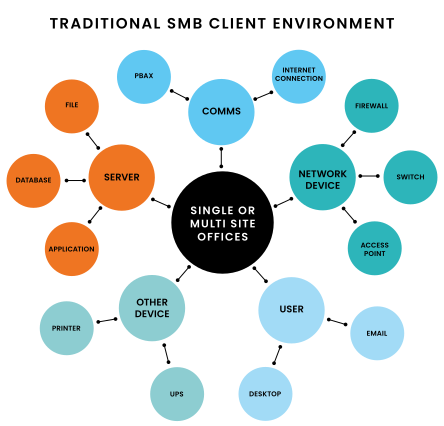
Traditional-SMB-Client-environment

While MSPs focused on stabilising and supporting infrastructure, Value-Added Resellers (VARs) followed a similar path, in a different way – focusing on supplying and configuring the hardware and software. Systems Integrators (SIs), meanwhile, played a more specialised role, stepping in to handle complex infrastructure builds or application deployments that sat on top of the environments created by VARs and MSPs.

Each technology partner played a vital part in shaping early ecosystems, bringing order to that complexity, and building more reliable, stable systems to help them grow. But the landscape has shifted dramatically since 2010. What’s changed?

  • The cloud has fundamentally changed how technology partners serve their clients.
  • On-premise infrastructure has shrunk for many organisations.
  • For some clients, network infrastructure has (also) scaled back.
  • For others, however, especially those adopting operational technology and IoT, networking requirements have expanded.

At the same time, the way end users engage with technology has also transformed. Laptops and mobile devices have replaced static desktops. People now work from anywhere. And, as a result, the once-centralised, “castle-and-moat” IT model no longer fits.
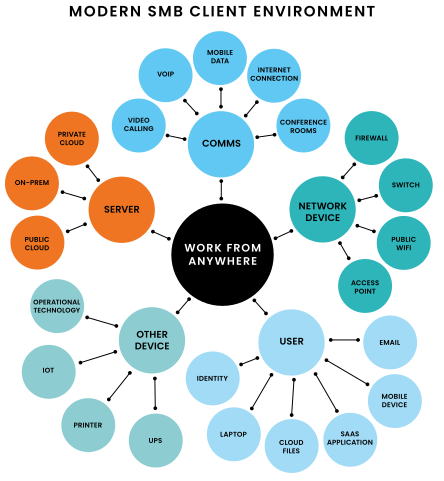
Modern-SMB-Client-environment

The Mindset Gap: Still Operating Like It’s 2010

Because so many partners were built on traditional models, it’s no surprise they’re now struggling to keep pace.

For years, many technology businesses have relied on long-standing, trusted relationships. But the landscape is shifting. Legacy clients are moving on. Owners are selling. A new generation of owners/decision-makers are stepping in, and they aren’t tied to the same loyalties. Their expectations are different, and they’re only going to continue to evolve.

Despite the dramatic changes in client environments, many technology partners are still operating from old technology solution categories like it’s 2010 – holding out hope that SBS (Small Business Servers) might somehow make a comeback.

But that ship has sailed!

The way clients are leveraging technology has evolved, and their infrastructure needs have shifted. It’s time to start thinking more broadly and elevating the role technology partners play.

Read more about: 4 Urgent Reasons the Technology Services Industry Needs to Transform

With core infrastructure now largely stable and foundational tech in place, clients have the headspace to focus on strategic outcomes. They’re looking for solutions that help:

  • grow revenue
  • boost efficiency
  • improve profitability
  • manage business risk

Not to mention, they have competing priorities, like managing operational complexity, and attracting and retaining talent, which is increasingly getting harder and harder.

To meet these challenges, technology partners need to view client environments through a new, broader lens – one that goes beyond infrastructure, to focusing on enabling outcomes through a solutions mindset.

From Infrastructure to Competitive Solutions

To remain relevant and valuable, technology partners need to shift toward a more advisory role – one that starts with truly understanding clients’ businesses.

That means moving beyond just technical support, to guiding clients through what could be described as the 12 core technology solution categories. And each of these categories contains a range of subcategories and specialisations.
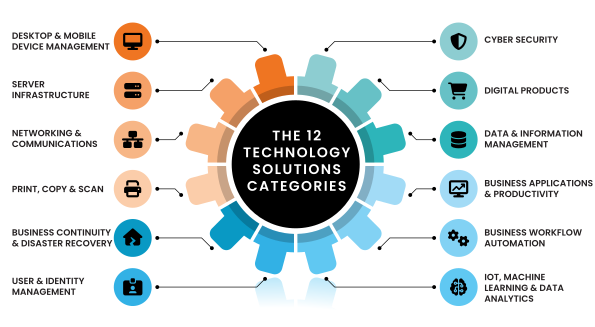
12-technology-solutions-categories

Clients increasingly expect their technology partners to have a working knowledge across this broader spectrum. That is, not just infrastructure, but applications, data flows, system integrations and more.

The challenge? Many partners come from an infrastructure-heavy background, so the shift to application-centric, data-driven environments can feel overwhelming. But clients are no longer just asking for help managing servers – they’re asking for strategic input across a far more complex technology landscape.

Whether you decide to build out these capabilities for your business internally, or by forming strategic alliances, having this broader perspective is becoming non-negotiable.

Choosing a Strategic Path: Advisor or Specialist?

At this point, technology partners need to make a deliberate choice:

1) Will your business evolve into a technology advisor – owning the client relationship, understanding the client’s business, and providing governance, ongoing advice and solution design?

Or

2) Will your business become a specialist – focusing deeply on a particular technology category and partnering with others in a channel model to deliver product-led solutions, at scale?

There’s no right or wrong answer here. What matters is clarity and intentionality.

Because as soon as you choose a direction, everything else needs to align. That is: how you engage clients, how services are monetised, and how your position yourself in the market.

Assessing Capability: Build, Acquire or Partner?

Using a structured framework across key technology solution categories can help clarify where your strengths lie. This can make it easier to define offerings, shape messaging and position solutions in market. From there, the next decision is how to deliver. Consider:

  • Should our capabilities be built in-house?
  • Should it be acquired, at scale – either by hiring experienced talent or buying an entire business?
  • Or is it smarter to leverage a partner network?

Whether you choose to build, acquire or partner, these decisions should align with the technology solution categories you want to lead in.
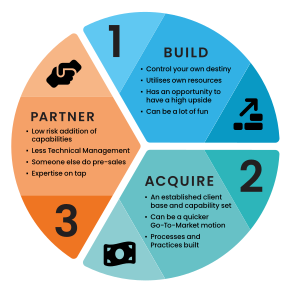
3-options-increase-deliverability

What’s worked in the past won’t necessarily lead to success in the future. Continue to ask strategic questions, such as:

  • Do we have the capability to support clients from an advisory perspective?
  • Can we design and deliver modern, relevant solutions?
  • And, can we do it all in a way that’s profitable and sustainable?

For many technology partners, the honest answer may be “not yet”, or perhaps, “not at all.” In some cases, it’s not a matter of lacking the skill, but the energy.

This is the moment where technology partners need to make a clear, deliberate decision: Will you transform to meet the needs of the modern client, or is it time to consider exiting the game?

If you aren’t proactively bringing a portfolio of solutions that help clients grow, boost profitability or mitigate business risk, it’s only a matter of time before someone else will – quickly and easily.

Let’s re-evaluate the technology solution categories, and cover three value streams you should be focusing on to adapt and thrive in today’s changing landscape.

The 3 Value Streams for Technology Solutions Partners

Value Stream 1: Advisory

The value stream you think you’re doing, but are probably not.

Advisory is a value stream that many technology partners believe they’re offering – but in reality, they’re not. Why? Because too often, the level of engagement is dragged down to the lowest common denominator.

Consider Quarterly Business Reviews

Take Quarterly Business Reviews (QBRs), for example. Many partners call this “advisory,” but too often, the people delivering them don’t have a deep understanding of the client’s business or technology. They may grasp one or the other, but they aren’t taking a holistic, high-level, strategic approach.

Clients are willing to pay well for true advisory services. But they’re looking for experts who can provide more than just operational insight – they need someone who can lead them through the complexities of their technology environment and guide their broader business strategy.

When a QBR focuses solely on reviewing traffic light reports (where progress is marked as red, yellow, or green) or upselling to modern compliance – that’s not true advisory.

Advisory means understanding your client’s business and offering proactive solutions that solve their real challenges, and add significant value. This shift in approach is where the real opportunity lies, as it’s where clients are willing to spend big dollars and invest in.

While your intentions may be good, take a moment to ask yourself: Do you truly understand your client?

Sense check

Pick a client at random and ask your Account Manager: “How does this client make money?”

If they can’t answer that question easily, it’s a clear sign your engagement is likely not at the advisory level.

Value Stream 2: Architecture

The value stream you should be charging for. And stop doing for free!

Architecture is a value stream that’s already a default part of your services. But it’s likely something you’re doing without charging for it.

Many businesses give away architectural services without realising it’s a high-value activity that should be monetised.

How can you do this? By shifting your mindset. Not just because it’s costing you money, but because it plays a critical role in solving complex business challenges.

The key is to distinguish between:

1) product-type solutions – which can be quickly scoped and delivered with a proposal

Vs.

2) more strategic architecture work – where you’re designing a solution tailored to the client’s needs and helping them make important business decisions.

One overlooked aspect of solution design is that forcing clients to commit to a budget, forces decisions. Sometimes, the most valuable decision is for them to say “no”.

Whether they decide to invest in a project or not, it’s still valuable and should be recognised as such in your approach with the client.

If you’re not charging for solution design and architecture, you need to start – because your clients require this level of expertise.

The only way to deliver this capability is by ensuring you have billable hours for your pre-sales team.

Value Stream 3: Enablement.

The value stream you’re overlooking.

There’s a value stream many technology partners are overlooking, but it’s one of the most crucial for end clients: enablement. This is often the most challenging because it centres around people.

Some might think they’re addressing it by offering a security awareness training tool. However, that’s simply procurement (reselling a product).

True enablement involves engaging people through training: guiding them through change with change management services and providing ongoing support. It’s about helping a client’s team members understand their roles and workflows, and then assisting them in transforming how they work to adapt to new workflow practices.

These are complex, often difficult services to deliver – especially when compared to a straightforward “lift-and-shift” technology rollout.

But they’re the services clients need and value most. Why? Because this is how they see a Return on Investment from their technology.

Consider this example

We’ve all seen it: a company implements a new ERP, only for the team to revert back to operating from spreadsheets, because no one helped them adopt the new system.

That’s what enablement is about.

It’s a massive opportunity. One that more partners need to start recognising, understanding and building toward.

Where to From Here?

To gain a competitive edge as a technology solutions partner, there’s no one-size-fits-all blueprint. But there is a clear need for intentionality.

Whether you’re leaning toward an advisory-led model, choosing to specialise in architecture, or building out true enablement capability, the goal isn’t to do everything. It’s to know what you do best, align your engagement and monetisation models to that strength, and transform with purpose.

Recognising the need to evolve is an important first step. Committing to action is what will set your transformation in motion and engage across different technology solution categories – for sustainable growth, lasting client value and long-term profitability.

Motivate to evolve, stay relevant and grow? Discover how Fractional Leadership Advisory can guide your transformation.


The 5 Phases for TSPs to Implement Operational Change

The TSP Advisory has spent years working closely with technology partners to implement operational change. It’s a core part of our work that involves helping businesses navigate the transformation journey to become true Technology Solutions Partners (TSPs), guiding them through the stages of operational maturity and the challenges that come with it. 

Previously, we explored the six stages of operational maturity. Now, it’s time to dive into the next step: how to implement real operational change. And it’s more than making improvements – it’s a structured, five-step process that will require you to take a step back and approach change strategically.  

Covering these five stages will hopefully enable you to identify gaps in your current approach and understand why past initiatives may have fallen short. Follow this proven process to apply it throughout all areas in your business and avoid common pitfalls. 

Tips Before Getting Started  

Set yourself up for success with the right mindset and preparation. Consider the following principles to create a solid foundation for change.  

Make Progress, Step by Step  

Skipping steps – whether that’s having unclear objectives, unrealistic expectations, or disjointed efforts – often leads to mistakes. The key is to slow down and take a deliberate approach. That means utilising things like strong business cases and clearly documented objectives, as well as ensuring everyone understands the “why”, costs, benefits and problems being solved. 

Treat Change as a Holistic, Long-Term Strategy 

The biggest snags TSPs tend to stumble on is either trying to do too much at once or focusing on isolated initiatives, instead of treating change as an integrated, long-term strategy. Setting a clear project timeline and defining milestones is not only an effective way to give people accountability, but provide them with the clarity they need for successful execution.  

With these guiding principles in mind, let’s explore the first phase of implementing operational change.  

The 5 Phases for Implementing Operational Change 

understand-icon

Phase 1: Understand 

The first phase, “Understand” involves building awareness. That is, gaining education around new concepts and best practices, so you can create a meaningful purpose, scope and assign responsibilities for driving change. 

Without a strong understanding of what you’re trying to achieve from the start (knowing what “good” actually looks like), it’s difficult to know what you’re aiming for. Skipping this vital first step can be detrimental to your progress, leading to confusion and misalignment before the real work even begins. 

document-icon

Phase 2: Document  

Once you’ve achieved clear understanding, the next stage, “Document” is all about preparation. You know what you’re trying to achieve, what best practices are and who is responsible for driving change. Documenting this is key!  

Here, documentation goes beyond recording goals or objectives. It’s about clearly defining:  

  • processes 
  • policies 
  • procedures  
  • specific actions you’re planning to implement.  

Many TSPs we support are surprised by this step, thinking it’s something that should be done later down the track. But in fact, it’s crucial at this point in your journey. Why? Because documenting everything in detail creates clarity. It lays the groundwork for sustainable change, embedded throughout your business long-term. (Lacking the right documentation often causes initiatives fail over time – as the detail needed to run an operationally mature business is overlooked or missing.)  

With processes, policies, and procedures in hand, you’re ready for the next step: communication and training.   

train-icon

Phase 3: Communicate  

By this stage, you’re ready to gain buy-in from your team. This involves communicating upcoming changes clearly and effectively.  

Often, businesses try to communicate changes either after they’ve been made or just before implementation – which doesn’t give your team members enough time to understand what’s happening. This is where your earlier documentation comes into play. You can share practical, pragmatic details with your teams to demonstrate exactly what’s being implemented and why. This allows them to grasp the full scope of the changes, have a frame of reference and understand how it will impact their work.

Importantly, it gives them the opportunity to provide feedback before changes are implemented and highlight potential issues or gaps that may have been overlooked. (Without concrete details to work off from the “Documentation” phase, they’ll likely find it difficult to provide meaningful feedback.)  If you miss this step, it can mean missing out on valuable insights from your frontline teams.  

The “Communicate” phase is a vital part of the process and creates a strong foundation for the next step.  

implement-icon

Phase 4: Action  

If you recall the introductory “tips”, all too commonly, technology businesses try to jump the gun by kicking off with this stage first – rushing into implementation without having fully planning the details, without understanding what “done” looks like, and without clarity on the goals. As a result, team members experience confusion, and implementation becomes prolonged and inefficient. 

Only once you’ve followed the previous phases will you be ready to take action and execute your plan. You should have a clear implementation strategy, well-defined timeline, launch expectations and contingencies plans before moving forward with implementation. 

The good news: When previous phases have been properly executed, this phase should actually be one of the easiest to implement, on time and on budget.   

Many businesses imagine their journey of operational change is complete here. But we’re not quite done yet.  

inspect-icon

Phase 5. Inspect 

The final phase, “Inspect”, is where we review the results of changes, learn from the process and make any necessary refinements. Even with the best preparations, there may be areas you’ve missed or issues that only became apparent after implementation. So, this is the time to refine and improve.  

It’s also critical to ensure you (1) have measurements in place and (2) assign people with responsibilities for managing ongoing efforts. This supports changes to become embedded, and sustainable into the future. That is, they become part of “normal practice”.  

Like most changes impacting people’s operational work methods, it typically takes up to 90 days to fully integrate these new habits, so they become routine. Empower your team members with the opportunity and time to “drive” these processes, embed them within the business and, hopefully, understand the process. 

Yes, it takes work. But it’s far more effective than constantly rolling out new initiatives that lack structure, trying to reverse poor implementation or making things up as you go. (Hidden costs like these can be high, and often why businesses feel so “busy”, spinning their wheels without making real progress).   

To achieve and ensure continued success, commit to this five-step process for every initiative.

Closing thoughts  

The time it takes to implement change will vary depending on the initiative and level of change required, but this is part of the ongoing process of transformation. The great thing about having this awareness is that you can slow down or speed up processes to proactively embed change within your culture.  

Overall, these phases will help you improve your TSP’s operational maturity – not only through the initiatives you deliver, but through the daily practices you consistently uphold.  

Hopefully, this has provided you with valuable insights, helped you identify areas where things can go offtrack and encouraged you to follow a new, more effective way of implementing operational change. 

Motivated to build sustainable, operational change in your business? Talk to the TSP Advisory. 

How TSPs Can Progress Through the 6 Stages of Operational Maturity (and Avoid Getting Stuck)

As a Technology Solutions Partner (TSP), the concept of your business’s operational maturity can feel subjective. You may feel like you can intuitively gauge it, but without a structured framework, it can be difficult to pinpoint exactly where you stand on the maturity scale. 

Until now, there haven’t been widely recognised standards to guide TSPs through this journey. That’s why The TSP Advisory has developed a comprehensive framework outlining the six stages of operational maturity for technology businesses. This system can provide you with a roadmap to assess your current standing, measure progress, identify gaps and figure out why you may be getting stuck along the way. 

Let’s start by diving into the six stages of operational maturity and explore how you can advance through them. Through objective measures, this framework can guide you with practices you can start undertaking now and what progress looks like as you grow up the maturity scale.   


What Are The 6 Stages of Operational Maturity?  

Let’s break down each stage, from 0 to 5, to explore what progression looks like. 

Stage-0-Icon

Stage 0: Just Starting  

This stage refers to TSPs getting off the ground and finding their feet. Processes and data-driven decision making are yet to be implemented. It often looks like reinventing the wheel or starting from scratch every time you take on a new task because business practices are still in the early stages of development.  

Stage-1-Icon

Stage 1: Forming 

As TSPs begin to progress, Stage 1 represents a time where informal practices are beginning to emerge. Team members rely on individual knowledge and experience to make decisions and accomplish tasks; however, there’s no consistent, repeatable methodology to guide them. Often too, owners are required to use personal knowledge to make micro-decisions on a regular basis.  

Stage-2-Icon

Stage 2: Developing  

At this stage of operational maturity, TSPs are developing their practices. That is, going from using individual knowledge to keeping records. This can look like:  

  • documenting workflows 
  • creating SOPs (Standard Operating Procedures) 
  • making processes repeatable  
  • implementing metrics.  

Metrics, though, at this stage may be simple, binary pass/fail measures. (For example, was the task achieved? Yes/No.) These measures are not detailed yet and owners are still responsible for the bulk of decision making.  

Stage-3-Icon

Stage 3: Solidifying  

Eventually, some TSPs start to progress and solidify with documented practices. While these practices may not be perfect, leadership teams are driving progress by owning different areas of the business and running through processes with their teams.  

In Stage 3, metrics are enhanced, and surrounding processes and practices are becoming more detailed. Roles and responsibilities start to emerge and become more important, as owners are no longer required to make every decision. Leaders are taking on more decision-making responsibilities to provide team members with clarity.  

Stage-4-Icon

Stage 4. Embedding  

Next, progressing to Stage 4, TSPs may begin to embed their practices in the following ways:  

  • end-to end processes become more measurable 
  • KPIs are established throughout the business, all the way to the frontline  
  • leadership teams are using data-driven decisions, supported by strong practices.   

Stage-5-Icon

Stage 5. Living It  

In Stage 5, people within the business are living practices each day. TSPs at this point have adopted a culture of continuous improvement – as the right business foundations are now in place. People know and own their responsibilities, and established measurements ensure they’re accountable. Leaders in the business are driving initiatives to improve efficiencies and productivity.  

While this may look like the typical journey of operational maturity for TSPs, the reality is there are a swathe of businesses that struggle to progress past stage 2. Why does this happen, and what can be done to fix it?  


Why Do TSPs Typically Get Stuck?  

For TSPs, standing still on the maturity scale can come down to lacking a clear picture about what “good” looks like. Consider this all-to-familiar example: a business has organically from the ground up, learned from community and industry events along the way, and cobbled together a relatively stable business with some documentation in place. In these cases, however, owners are still responsible for the majority of decision making. The business itself is held back by:  

  • not transitioning to deeper, more detailed metrics  
  • not outlining and delegating responsibilities with clarity  
  • not driving continuous improvement.  

Here lies the advantage of our operational maturity framework. While applying it involves some nuance, The TSP Advisory supports businesses to utilise it across all functional areas, including sales, service delivery, projects, HR, finance, procurement and beyond.   


How Can You Start Making Real Progress, and How Long Does It Take?  

Applying this maturity model across operational functionality enables you to measure maturity in all areas. This can help you focus on what initiatives need to be improved in what areas, and what areas need the most attention to mature. (This can mean letting go of doing things the traditional way, “as that’s always how it’s been done”.)  

Think: where do the fires most commonly occur, what causes the most complaints, where are the biggest growing pains, what areas are the most reactive?  

From here, you can begin to plan your transformation programme over years to improve practices.  

The important word to note in this case is: years 

In our experience, it takes most businesses three to five years to progress from one stage to the next, even if you’re an established business taking deliberate direction. As an owner starting a technology services business, you typically have to learn, while implementing. As such, it takes time to develop the right “cultural DNA”.  

While lasting change can’t typically be fast-tracked, the only exception could be if, as an owner, you’ve done it before.  

For TSPs with a highly-experienced leadership teams, it’s possible to move from Stage 0 (Starting) to Stages 2 or 3 (Developing or Solidifying). Progressing through these stages is achievable if you have people within your culture already experienced at these levels. It’s unlikely though, you’ll be able to move from Stage 0 to 5. Why?  

Let’s consider an example: account management.  

You’re motivated to implement Quarterly Business Reviews and you know what “good” looks like as an industry standard. However, your teams haven’t started a regime of speaking with clients in the first place. In this case, trying to go from Stage 0 to 5 is unrealistic.  


Is Reaching Stage 5 “Living It” a Reality?  

There are many transformation steps that are needed to build:  

  • the body of knowledge in your business  
  • the right rhythms  
  • a strong culture  
  • operational experience at a maturity level.  

This is why understanding your current position and determining next steps are far more important than focusing on “utopia”. Using the pragmatic, step-by-step operational maturity framework is what helps businesses progress. That is, continuous improvement and maturity is more important than trying to go from Stage 0 to 5.  

There are so many moving pieces in your business, nuance and things to learn and appreciate. The maturation journey itself is critical to a business learning. Businesses need to get familiar with practices before embedding them within ourselves and cultural DNA.  

Hopefully, this overview has given you a clear starting point to understand the six stages of operational maturity and where your business might currently stand. We’ll continue to share resources to break down each stage into practical, tangible insights you can apply to your own journey. This framework can help you identify where you are, where you want to go and how to navigate the path ahead. 

Improve your ability to progress through the stages of operational maturity. Talk to the TSP Advisory.

What is a Technology Solutions Partner?

The technology industry is evolving – fast. Client expectations are shifting, traditional business models are under pressure, and the terminology used by technology partners is no longer keeping pace.  

For years, Managed Service Providers (MSPs), Systems Integrators (SIs), and Value-Added Resellers (VARs) have each played important roles in the industry. But as technology services become more commoditised and standardised, these labels are no longer enough. Many businesses are realising that their current positioning isn’t well-equipped for the future.  

Let’s examine key challenges causing these industry shifts, how the concept of a Technology Solutions Partner can make a meaningful difference, and the business models that can act as a guiding light for building more resilient, future-ready businesses. 


Why Traditional Technology Business Models Are No Longer Future-Proof 

One of the most common concerns we hear from technology businesses is that the industry is transforming rapidly and traditional models are falling behind. Factors accelerating these changes range from shrinking margins and shifting client demands, to vendor consolidation and lack of differentiation.  

Of course, traditional business models still exist. Just imagine your local break-fix IT companies and old computer shops. But are they growing, or turning a profit? Most often, no. They’re simply surviving.  

For starters, let’s consider the term Managed Service Provider (MSP). It has many connotations and hasn’t been used to its best advantage in the industry. While many people understand MSPs are focused on end user support, with IT infrastructure management at its core, clients don’t typically connect with this terminology. Vendors and distributors alike consider it a ubiquitous term. The business model itself limits how these business can operate, grow and engage clients.  

Other business models are in the same boat, such as Systems Integrators (SIs), which focus on a technology speciality, driven by professional-services. As well as Value-Added Resellers (VARs), product-driven businesses, that may also sell services. Neither of these are MSPs. But the industry has been using this term for so long, many think they need to become an MSP to keep pace – even though the reality of delivering these services isn’t in line with their goals. They may gain some traction in the MSP space, but it’s short-term fix.  

So, what is the goal? Most often, it’s securing regular, guaranteed, recurring income from ongoing services.  

Achieving this is possible. But it starts with broadening your mindset.  


How Can We Create Meaningful Change?

The turning point isn’t coming – it’s already here. So, for technology businesses to be successful, it’s worthwhile to make the shift from being reactive to being proactive.   

Enter: The Technology Solutions Partner, and fundamental mindset shift for making an effective pivot. What does this terminology mean, and how does it make a difference? Let’s break it down in more detail.  

Technology  

Technology is a holistic term that captures cyber and IT, as well as communication tools. All businesses have technology needs, and they need partners to help them through their journey.  

Solutions  

Solutions go beyond transactional services. Instead of commoditised, standardised delivery, it requires you to have a true understanding of your clients need. This enables you to: 

  • provide solutions to real business problems 
  • create opportunities for them to become more efficient and grow  
  • help them understand and mitigate risks  
  • leverage technology to support them in scaling their business.  

(“Services” just doesn’t cut it!)

Partnership 

Partners do more than transactional providers. Providers deliver and bill, without developing relationships with customers or offering additional value. Partners, on the other hand, offer a white-glove service. This is particularly valuable in the SMB space, where many technology businesses value client relationships and offering value-add services.  

Since clients value partnerships, why not embrace this mentality? This could mean developing traditional partnerships, or elevating your services to become a strategic business partner. This can also look like partner-to-partner relationships – for instance, owning relationships with small business clients, then leveraging other technology specialists to provide delivery in their specific capability area.  

Needless to say, there’s nuance to being a Technology Solutions Partner. It isn’t a one-size-fits all approach. While you may opt for a different term, it’s a concept that can act as a guiding light. It can fundamentally reshape your purpose and direction for the better.  


Key business models for Technology Solutions Partners 

We’ve covered the concept, but what does it look like in practice? Here are a few TSP models that may spark your interest.   

The Technology Broker 

Technology brokers engage with clients needing a procurement partner. This goes beyond procuring straight hardware as traditional VARs do, with additional services. It can involve procuring hardware, but also SaaS, cloud solutions, communications tools, services from other partners, and more. This type of partner acts as a conduit, similar to an insurance broker, providing avenues to a variety of options and specialists, without managing 100% of delivery.  

The greatest benefit for the client is that they simply maintain a strong relationship with their broker, who provides them with best-of-breed solutions that are relevant and advantageous for them, as well as proactive guidance and direction.   

The Boutique TSP  

This type of TSP an advisory-led organisation. Grounded in business consulting and advisory-level engagements, they provide clients with governance, compliance support, and implementation assistance for different technologies that suit clients’ needs. Boutique partners offer highly-personal relationships, led by a deep business understanding.  

The Specialist TSP  

Specialist TSPs have deep expertise within a technology category. They offer high-level resources, ongoing services, and are capable of delivering project work.  

How is this different to a traditional SI? The Specialist builds a channel model – using partner-to-partner play to amplify their efforts. They may not be primary relationship holders, but they play a foundational role in delivering technology solutions for different businesses.   

The Scaled TSP  

Similar to large MSPs, scaled TSPs are focused on consolidations, acquisitions and market expansion. They deliver generic, standardised solutions that can be delivered at a cost-effective rate through things like:  

  • automation 
  • offshoring 
  • other cost-effective offerings.  

Why is this effective? Not all clients need or want white-glove service. Many simply require specific solutions delivered to them – solutions they can afford, and scale.  

As traditional offerings continue to become commoditised and delivery becomes cheaper, scaled TSPs may find themselves obtaining greater market share. Clients may opt for cheaper offerings with service providers that don’t need to provide extra value.  


There’s No One-Size-Fits-All

For certain clients, you may experience some overlap between these areas. So it’s important to note, you don’t necessarily have to fit into a singular category. You may progress in one area, then find yourself branching into another. The business models above, however, are a great starting point to determine:  

  • what you’re aiming for 
  • how to design and structure your business model  
  • your core financial drivers 
  • the type of partners you need in your ecosystem to be successful.  

Whether your call yourself a technology solutions provider, a technology partner, a procurement partner, an ITC partner, or something else entirely – it’s no matter. Simply harness the Technology Solutions Partner concept as a roadmap for your transformation journey.  

The important thing is to determine your ideal clients, identify what matters to them, and speak their language.


Final thoughts  

For technology businesses, it’s clear standing still isn’t an option. Hopefully, with these ideas for embracing a new approach – becoming a Technology Solutions Partner – the future is looking a little brighter.  

Take a moment to stop and reflect on where you are now, compared to where you’d like to be in the future. Be deliberate about whether your goal is to exit in the short-term, or transform for the future.  

If you’re ready to transform, it’s time to create a new identity for your company. Identify what you’re trying to achieve, what your current capabilities are, and what you need to develop for the future.  

The path ahead may be challenging, but the TSP framework is a great way to move forward with greater confidence.  

Motivated to learn more about TSP models? Learn more.  

4 Urgent Reasons the Technology Services Industry Needs to Transform

The IT industry is rapidly evolving, driven by a number of changes that are both technological and human. For technology businesses, you’re likely experiencing these impacts firsthand.  

To fully grasp the significance of these changes, let’s consider the nature of the industry until this point. Traditionally, three business models have coexisted within different market segments. Managed Service Providers (MSPs) provide end-user support and infrastructure management, helping SMEs fix problems and get up and running. System Integrators (SIs) who traditionally are within the mid-market and enterprise now coming down to SMB to grow. SIs offer technology specialisation, with a focus on delivering projects. And Value-Added Resellers (VARs), who typically work with IT Managers and other Technical Professionals to provide procurement. VARs are built on selling hardware and complementary service packages, have evolved to resell other products, and expand in areas like networking, servers, and cloud SaaS subscriptions.  

The thing is, technology is changing. Client needs are changing. And the weight of these changes is causing traditional technology business models to buckle. Complacency is a luxury you simply cannot afford. 


What’s Driving the Industry to Transform?

There are a number of factors accelerating change, from technology innovation, to shifting client demands. Here are four of the biggest.  

1. Margins are Shrinking  

Over the years, competition has only grown fiercer. The value technology businesses once provided is now no longer unique. (Just search most major cities for MSPs, for example, and you’ll find a handful scattered throughout the area.)  

This means clients have more choice than ever. But businesses have become so commoditised that everyone looks the same. You’ve likely seen it time and time again-the same website colours, branding, language, messaging, and positioning. All this has created an environment driving prices down.  

 2. Industry Demographics Are Shifting  

Many MSPs are still owned and led by their founding generation. As more of these owners begin to exit, we’re seeing a wave of acquisitions and consolidation. Large players, in particular, are rolling businesses together to achieve economies of scale, while automation and competitive pricing are putting additional pressure on smaller providers. 

For long-standing MSPs, adapting to this shift is a challenge. Many traditional firms lack a clear strategy for differentiation, direction around opportunities like workflow automation, or ways to position themselves as true technology advisors to add unique value for clients.  

3. More Vendors are Consolidating  

Large technology ecosystems (such as Microsoft, Google, and AWS) are acquiring and integrating more solutions into their platforms. This is creating more vertical silos, reinforcing long-term customer dependency.   

As more customers increasingly seek integrated, all-in-one solutions or rely on a single provider, IT businesses face heightened vendor lock-in, reduced differentiation, and mounting pressure to keep prices competitive without sacrificing margins.  

Vendor consolidation may also be a factor slowing growth for PSA (Professional Services Automation) and RMM (Remote Monitoring and Management) solutions. With more businesses relying on built-in solutions, PSA and RMM providers are struggling to drive growth through new customer adoption. 

4. Client Needs and Expectations are Changing 

Ultimately, your clients’ needs and expectations matter most, and they’re evolving rapidly in multiple ways. Your clients may be leveraging technology to increase efficiency, scale, growth, and reduce risk. Additionally, they may be challenged by finding technical talent, rising salaries, and increasing delivery costs – turning to technology to tackle these problems. As innovation accelerates, they’re also demanding smarter, faster, more personalised solutions.  

Given this plethora of challenges, it’s apparent that the days for traditional technology business models are numbered. Without true IT transformation, businesses in the industry risk falling behind.  

But the good news is this: with the industry at a crossroads, the traditional market is ripe for transformation. There is plenty of opportunity to grow through acquisition, embracing change, and achieving economies of scale.  

 

What is the Key to Business Transformation?  

If you’ve noticed industry leaders bundling partner models under MSP terminology, you may think this wording isn’t appropriate for your circumstances. And rightly so. Clients, too, have never embraced terminology like MSP, SI, or VAR. So, what terminology is more appropriate?   

Transforming the industry starts with a fundamental mindset shift: from being a “IT services provider”, to a “technology solutions partner”.  

Why does this language matter? It articulates a change and direction that makes sense for technology businesses. You’re not providing services, you’re providing solutions!  

Consider commoditised services such as electricity, cleaning, accountancy. Services are often straightforward, transactional exchanges. There’s minimal relationship building and maximised commoditisation.  

Technology solutions partners should be providing business solutions – technology solutions that solve real business problems for clients. This is fundamentally different to providing a technical service.  

Your goal then becomes understanding the unique business challenges your client is facing and delivering solutions in a way that resonates with them, not just in technical terms.  

Making the shift, from provider to partner, means offering advice, building relationships, becoming a technology advisor and fostering deeper, long-term connections with clients that stand the test of time. It can also involve building partnerships with other tech partners.  

One important thing to note is this: the concept of being a “technology solutions partner” isn’t a one-size-fits-all business model. There are multiple, cohesive models that can fall under this category and many ways to engage with clients to understand and meet their needs. Think: technology procurement partners, technology specialists, boutique TSPs. You can even leverage the expertise of other partners to deliver a cohesive, comprehensive solution for clients – meaning you don’t need to solve every single one of their problems yourself.  

With this in mind, how can we truly understand the business challenges our clients are facing, then productise, package, explain and provide solutions that meets these challenges in a way they can understand? How can we become partners, instead of transactional providers?  


How to Transform into a True Technology Solutions Partner  

If you’re ready to make the leap to transform your technology business and become a true technology solutions partner, let’s focus on how you can create real, lasting value for your clients. 

Offer Flexible Pricing and Packaging  

Be sure to price and package solutions in ways that are suitable and flexible for your clients. Maintain a “solutionised” mindset around project delivery that’s repeatable and profitable. 

Drive Growth Through Advisory  

Engage your clients in a more proactive, advisory role where your expertise adds strategic value to their business. Monetising these relationships creates new revenue streams, while developing stronger, long-term partnerships. 

Focus on Client Engagement 

As end-user support becoming less profitable or rewarding for business growth, delivering proactive client engagement is a great way to create deeper, more meaningful relationships. It can even help you anticipate and solve challenges before they arise. 

Facilitate Self-Service for End-Users 

Of course, providing support for end-users can still be valuable. But consider leveraging technology to enable end-users to solve their own problems and service requests.  

Build Trust with Governance and Transparent Reporting 

Providing governance and compliance with transparent reporting and information empowers clients with the knowledge they need to understand the action you’re taking. It’s a valuable way to develop their trust and confidence in your abilities to support compliance requirements and manage their business needs effectively. 

Empower Senior Leaders  

Provide senior leaders with the knowledge and insights they need to understand how technology can align with and drive their business objectives. This ensures they are equipped to make informed decisions and can actively support strategic initiatives that contribute to long-term success. 

Leverage Other Technology Partners 

It’s hard to be everything to everyone. Sometimes being a generalist or doing it all yourself just isn’t the best approach. Consider the value of leveraging other technology partners to embrace specialisation over generalisation. Collaborating with other specialists can help you add greater value for clients and position yourself as an expert.  


Can you see your business moving in this direction?  

If so, it’s clear to see the time has come to take the reins of transformation and steer your technology business with a proactive intent and strategy. It isn’t just about keeping up. It’s about leading the charge, embracing the future with purpose, making a real difference for your business, and reshaping the way you deliver value for clients.   

Use these insights move forward with purpose. The time to act is now—complacency isn’t an option.  

Motivated to transform your technology business? Start a conversation with The TSP Advisory 

james-davis-photo-lg